Resources
Depression resources
This page lists places to find help, places to learn more, and a small set of related reading. It's curated, not exhaustive. Every link points to a source that a clinician would recognize.

Sister publication
AnxietyResource.org
AnxietyResource.org is a sister publication of DepressionResource.org, edited by the same physician reviewer. It covers anxiety, panic, overthinking, and related conditions in the same plain-language editorial style. Both sites are publications of shrinkMD Publishing, LLC.
Section B
National mental health resources
- NIMH Depression page
The National Institute of Mental Health page on depression, with overview, research updates, and patient-facing information from the federal mental health research agency.
- SAMHSA
The Substance Abuse and Mental Health Services Administration, the federal agency that runs national service lines and funds community treatment for mental health and substance use.
- FindTreatment.gov
A SAMHSA-maintained searchable database of mental health and substance use treatment providers across the United States, filterable by location, payment, and services offered.
- NAMI
The National Alliance on Mental Illness, the largest grassroots mental health organization in the United States, with a free helpline, education programs, and local affiliates in every state.
- Mental Health America
A community-based nonprofit that hosts the most widely used set of free, validated mental health screening tools and produces patient education materials.
- CDC Suicide Prevention
The Centers for Disease Control and Prevention page on suicide, with the most current public health data, prevention strategies, and resources for survivors.
- American Psychiatric Association
The professional organization for psychiatrists in the United States, with clinical practice guidelines, position statements, and patient-facing education on every major psychiatric condition.
- PubMed
The NIH searchable database of biomedical literature, with abstracts and links to the full text of most published medical research.
- Cochrane Library
A nonprofit collection of systematic reviews of clinical evidence, considered one of the most rigorous summary sources for what works in medicine.
Section C
Related educational sites
Section D
Books and related reading
These are books written for the general reader by Shariq Refai, MD, MBA, board-certified psychiatrist. They're listed here as related reading and aren't sold on this site.
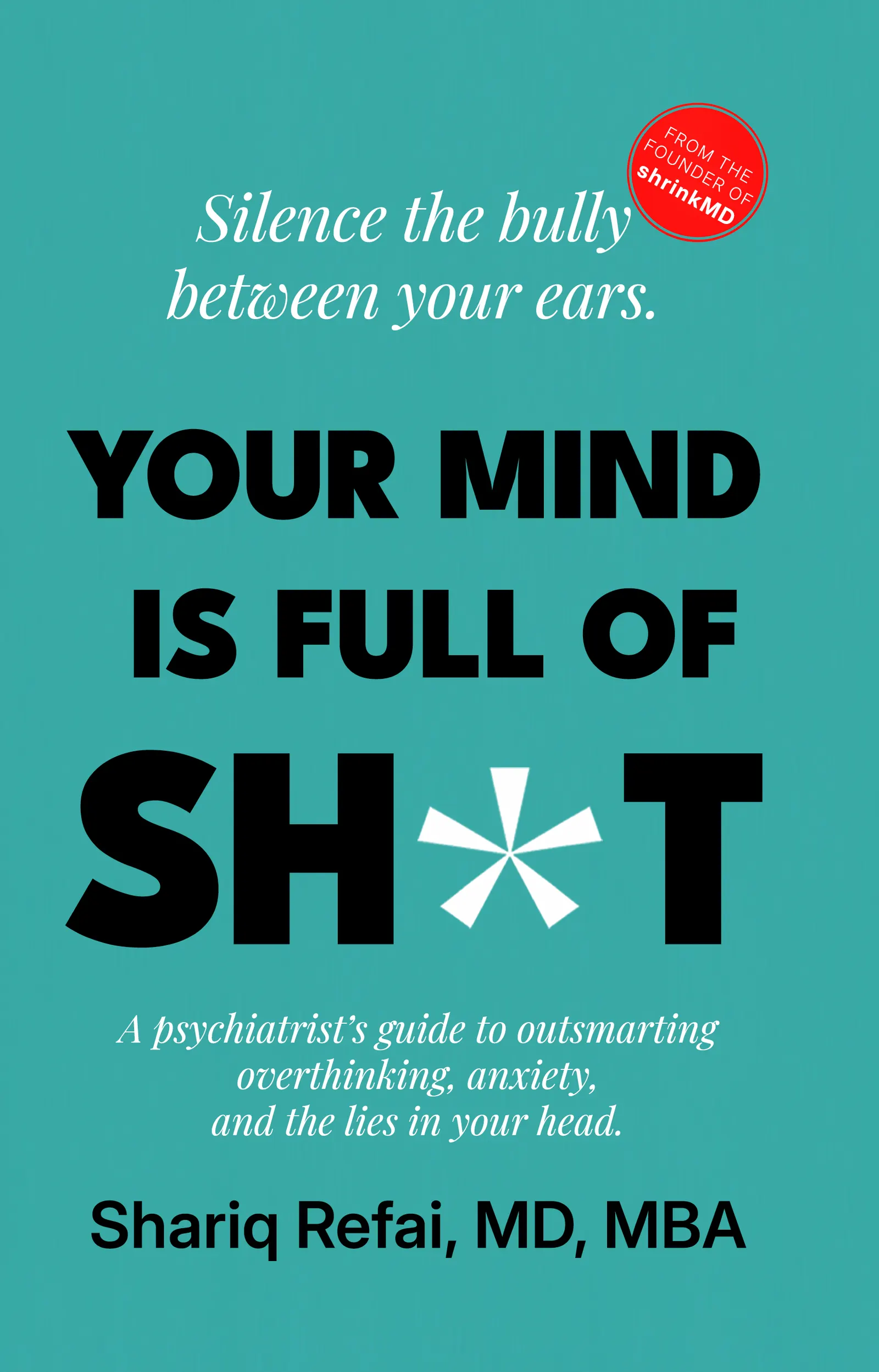
Your Mind Is Full of Sh*t
By Shariq Refai, MD, MBA
Your Mind Is Full of Sh*t: The Workbook
By Shariq Refai, MD, MBA
The Havoc in Your Head
By Shariq Refai, MD, MBA
Author site: shariqrefai.com
Section E
Insurance and access
Cost is one of the most common reasons treatment doesn't start or doesn't continue. The options below are the ones most patients have access to and most often miss. None of this is legal or financial advice.
Mental Health Parity and Addiction Equity Act
A federal law that requires most large group health plans and insurers to cover mental health and substance use treatment on the same terms as medical and surgical care. If a plan denies a mental health claim that would be covered for a medical condition, the parity law is the basis for an appeal.
Employee Assistance Programs (EAP)
A benefit offered by most large employers that provides a small set of free, confidential counseling sessions and referrals to longer-term care. Coverage is separate from the medical plan, and use of an EAP isn't reported to the employer.
Flexible Spending Accounts (FSA) and Health Savings Accounts (HSA)
Pretax accounts that can be used to pay for therapy copays, psychiatry visits, and most prescribed medications. HSAs roll over year to year. FSAs usually don't.
Sliding-scale and community clinics
Many therapists, training clinics, and community mental health centers offer fees on a sliding scale tied to income. Open Path Collective and the Psychology Today directory both filter for sliding-scale clinicians. Federally Qualified Health Centers (FQHCs) provide care regardless of insurance status, with fees based on income.
Medicaid and Medicare
Both programs cover psychiatric evaluation, medication management, and psychotherapy when delivered by an approved clinician. Coverage details vary by state for Medicaid. Medicare Part B covers outpatient mental health visits with a deductible and coinsurance.
Section F
Advocacy organizations
These organizations work on policy, parity enforcement, research funding, and access to care. They're also useful starting points for people who want to be involved beyond their own treatment.
- NAMI Advocacy
The advocacy arm of the National Alliance on Mental Illness, working on federal and state mental health policy, parity enforcement, and crisis-response reform.
- Mental Health America (advocacy)
Federal and state policy work on prevention, early intervention, and access to mental health treatment, with a particular focus on screening and parity.
- Project HEAL
A national nonprofit that funds treatment access for eating disorders, which co-occur with depression in a substantial group of patients.
- American Foundation for Suicide Prevention
A nonprofit funding suicide prevention research and policy advocacy, with local chapters and survivor support programs in every state.
Section G
Podcasts and films
A short, curated list of audio and visual material that patients and clinicians have found useful. None of this is treatment. The list is meant as a complement to clinical care, not a substitute for it.
Podcast
The Hilarious World of Depression
A long-running interview series in which comedians and writers describe their own experience with depression. Out of production but the back catalog is freely available.
Podcast
Terrible, Thanks for Asking
Nora McInerny interviews people about hard things, including grief, depression, and anxiety, in a way that takes the experience seriously without flattening it.
Podcast
The Happiness Lab
Yale psychologist Laurie Santos translates research on mood, behavior, and well-being into short, accessible episodes.
Podcast
Hidden Brain
Shankar Vedantam covers research on behavior, mood, and decision-making across many episodes that touch on depression and related conditions.
Podcast
On Being with Krista Tippett
Long-form interviews about meaning, mental health, and the inner life. The conversations with Bessel van der Kolk and Resmaa Menakem are common starting points.
Podcast
Mental Illness Happy Hour
Paul Gilmartin interviews comedians, artists, and others about mental health. Long-running and widely cited as helpful by patients.
Film
Melancholia (2011)
Lars von Trier portrays the lived experience of severe depression with unusual fidelity. Patients often describe it as the closest film representation of what an episode actually feels like.
Film
Inside Out (2015)
A Pixar film whose structure was developed with consultation from clinical psychologists. A useful entry point for talking about emotion with children and teens.
Film
A Beautiful Mind (2001)
A dramatized account of John Nash and his experience of schizophrenia. Often used in education on serious mental illness, with the caveats common to any biographical film.
Film
The Hours (2002)
A film built around three women separated in time, all living with depression. Honest about the day-to-day texture of the condition.
Section H
Find a clinician
The starting point for most people is a primary care visit, where a depression screen and a first conversation about treatment can usually happen the same day. For ongoing therapy, the Psychology Today directory is the most widely used way to filter by location, insurance, and specialty. Open Path Collective filters specifically for sliding-scale fees. For psychiatric medication management, our guide to finding a therapist or psychiatrist covers what to ask on a first call. The state-by-state resource pages list crisis lines, public mental health services, and notable treatment centers in each state.
Sources
- National Institute of Mental Health. Major Depression statistics and resources. NIMH, 2022.
- Substance Abuse and Mental Health Services Administration. National Helpline and FindTreatment.gov. SAMHSA.
- Centers for Disease Control and Prevention. Suicide Prevention Resource Center.
- American Psychiatric Association. Practice Guideline for the Treatment of Patients with Major Depressive Disorder.
- Mental Health Parity and Addiction Equity Act of 2008 (federal statute).
Frequently asked questions
What's the fastest way to get help for depression?
What if I can't afford care?
What government resources are available?
Does insurance have to cover mental health care?
How do I find a clinician who takes my insurance?
Reviewed by Shariq Refai, MD, MBA. Last reviewed March 15, 2026.